Cleaning Routines & Systems
The Weekly Cleaning Schedule You Can Actually Stick To
The site's core weekly system, year-round.
Read the post →
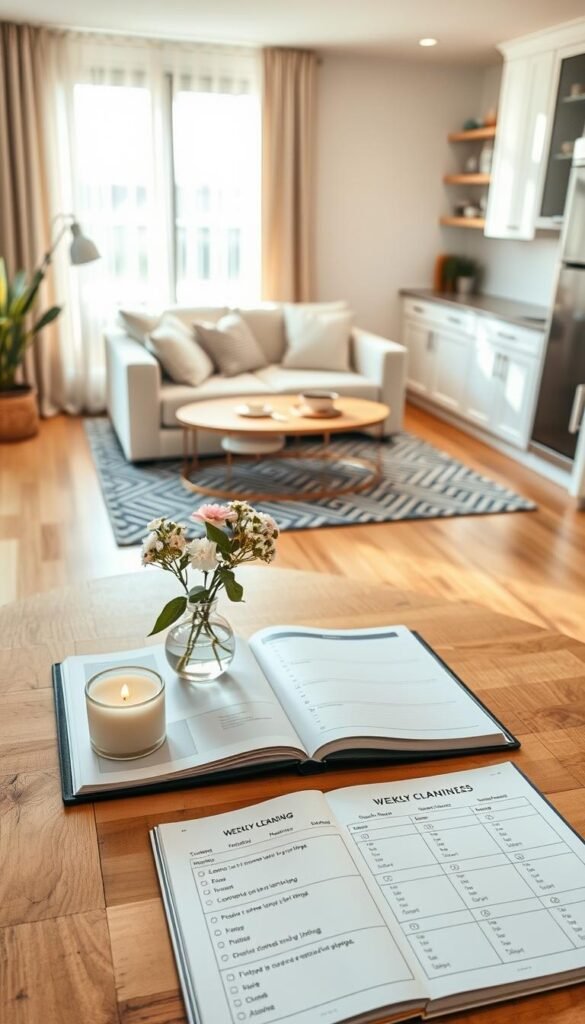
January tends to arrive with big cleaning ambitions — a whole new system, every room deep-cleaned, a routine that finally sticks. Most of those ambitious versions don't survive past the second week, not because the motivation wasn't real, but because the plan was sized for someone with more free time than most people actually have in January.
This is a smaller, more realistic version: a weekly schedule built to survive an ordinary January — school starting back up, work picking back up, the holiday glow already fading — rather than one that only works during the unusually motivated first few days of the year.
Your regular cleaning supplies, a spot to post the schedule where you'll actually see it, and about 15–20 minutes a day, five to six days a week.
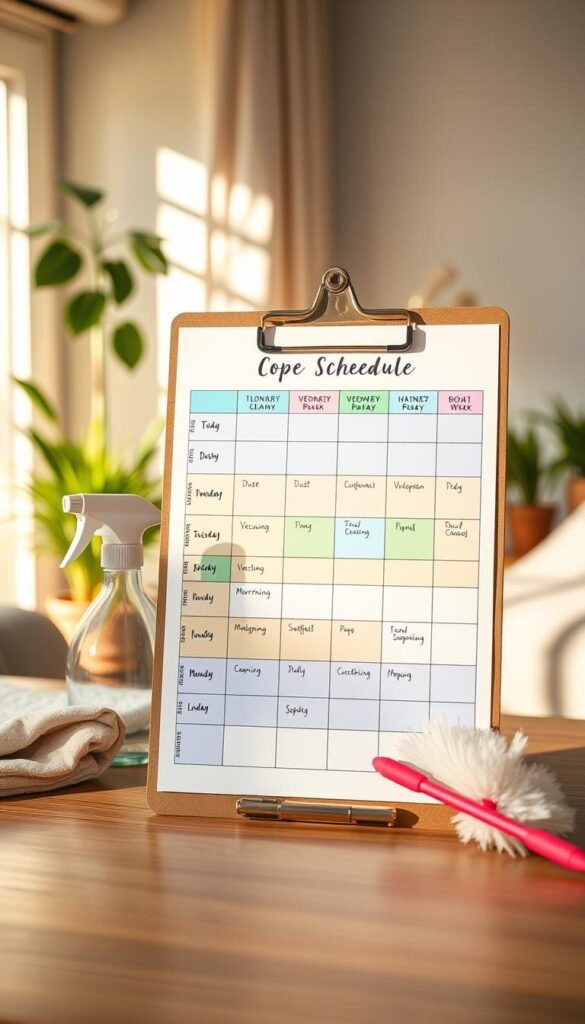
| Day | Task | Time |
|---|---|---|
| Monday | Kitchen reset | 15–20 min |
| Tuesday | Bathrooms | 15 min |
| Wednesday | Floors | 15–20 min |
| Thursday | Dusting & surfaces | 10–15 min |
| Friday | Laundry catch-up | varies |
| Weekend | Weekly reset | 20–30 min |
It helps to understand why these particular six tasks, in this particular order, make up the schedule. The kitchen goes first because it's the room with the most daily use and the fastest visible payoff — a clean kitchen changes how the whole house feels more than any other single room. Bathrooms come early in the week because they're quick, contained jobs that are easy to keep on top of before they become a bigger project. Floors land mid-week deliberately, catching the buildup from a busy weekend before it has a chance to compound further. Dusting is placed after floors so that anything knocked loose during vacuuming gets caught in the same pass, not a separate one. Laundry gets its own day rather than being squeezed in around other tasks, because it's the one job most likely to be neglected if it doesn't have dedicated time. And the weekly reset closes the loop — the moment where the whole week's effort becomes visible at once, which is what makes the whole schedule feel worth continuing.
Skip adding deep-clean tasks to this weekly schedule — ovens, baseboards, and windows belong to a separate monthly or seasonal routine, not a sustainable weekly one. Skip trying to make every week identical; a holiday, a busy work week, or a sick day is a normal reason to do a lighter version, not a sign the system has failed.
What if a specific day of the week never actually works for me?
Rearrange the schedule entirely around your real week — the specific day matters far less than having each task assigned to some fixed day rather than "whenever."
How is this different from a general weekly cleaning schedule?
This version is intentionally scaled down for January specifically — shorter daily tasks that account for a month when energy and time are often lower than usual after the holidays.
Do I need to do the weekly reset every single week?
It's the step most worth protecting if you're short on time some weeks — it's what gives the rest of the schedule its payoff and keeps the whole week from feeling incomplete.
Should I follow this schedule year-round?
Many households do, since the daily time commitment is realistic beyond January too — feel free to extend it once the new year settles into a normal routine.
What if I fall behind on more than one day?
Skip straight to today's task rather than trying to catch up on everything you missed — a schedule that requires catching up to stay valid isn't sustainable, and picking up where you are keeps it working.
How do I know if the schedule needs adjusting for my home?
If one day consistently takes much longer than the time allotted, that's a sign to split the task across two days rather than assuming you're doing something wrong — the schedule is a starting point, not a fixed rule.
Want this as a printable schedule to post at home? The free Weekly Cleaning Schedule has the full printable version.
Get the Free Weekly ChecklistA cleaning schedule that survives past January isn't the most ambitious one — it's the one sized for a real week. Fifteen minutes a day, six days a week, and the house stays consistently calm long after the new year feeling fades.
The site's core weekly system, year-round.
Read the post →The full four-week reset this schedule maintains.
Read the post →