Decluttering & Minimalism
The 30-Day Declutter Challenge: One Small Task Per Day
A real 30-day challenge with a different, specific task each day.
Read the post →

Whole-house decluttering fails for a simple reason: it isn't actually one task, it's dozens of small ones pretending to be one big one. Moving through your home one room at a time, with a clear method for each item, turns an overwhelming project into a series of short, doable sessions.
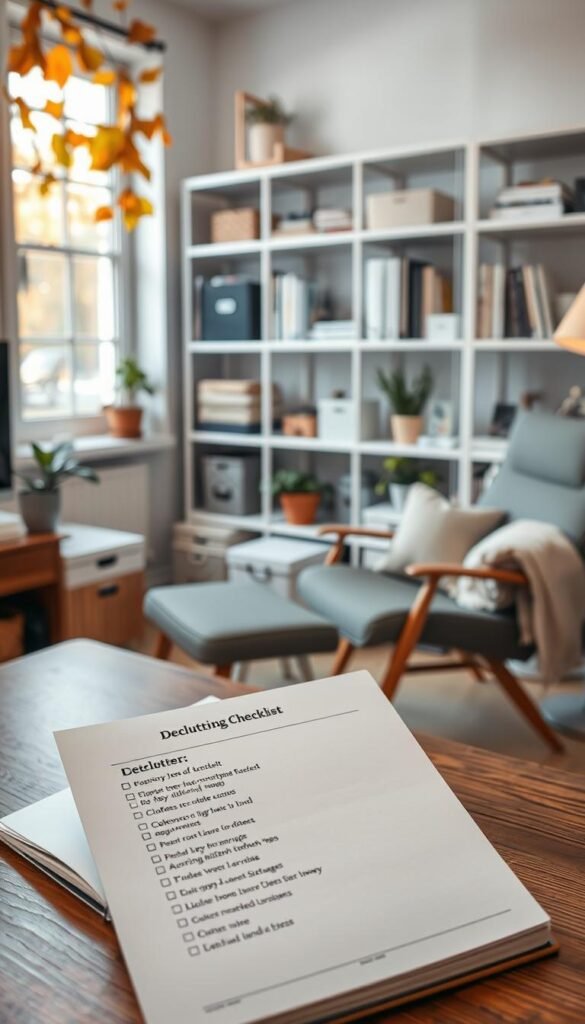
This checklist isn't about clearing your whole house this weekend. It's a repeatable method — the same five sorting rules, the same short timed blocks — that you can apply to any room, in any order, whenever you have fifteen spare minutes. Some weeks you'll finish a whole room. Other weeks, one drawer is enough. Both count.
Trash bags, a donation box, a recycling bin, labels if you want them, and a timer. Set up five sorting spots before you start: Keep, Relocate, Donate, Sell, Discard.
| Room | Start here |
|---|---|
| Living room | Coffee table and one shelf |
| Bedroom | Nightstand and one dresser drawer |
| Kitchen | One counter and the junk drawer |
| Bathroom | Medicine cabinet and under-sink |
| Entryway | Shoe pile and coat hooks |
If you've started this before and lost momentum, it's usually one of a few things:
Sentimental items deserve their own slower pace — don't fold them into a regular fifteen-minute room session. Set them aside in their own box as you go, and give yourself a separate, unhurried session later just for that box, ideally with a cup of tea and no timer running. Most people find that once the practical clutter is gone, the truly sentimental pieces are easy to spot, because they're the ones that clearly stand apart from everything else.
Skip trying to declutter every room in one weekend — the timed, zone-by-zone approach is what makes this sustainable. Skip debating over items you're not sure about; the "decide later" bin exists precisely so indecision doesn't stall your progress.
Which room should I start with?
Start wherever bothers you most daily — momentum from a visible win in a high-traffic room tends to carry into the rest of the house.
How long does the whole house take?
Most homes take several weeks of short sessions rather than one marathon — and that's genuinely fine. There's no deadline that matters here except the one that helps you.
What if I get through the "decide later" bin and I'm still stuck?
Give yourself a simple rule: if you haven't used or thought about it in a year, it can go. That single rule resolves most lingering maybes.
Should I declutter before or after a move?
Before, whenever possible — it's far easier to sort at a relaxed pace in your current space than to unpack duplicates and unused items into a brand-new one.
What's the realistic timeline for a whole house?
For an average home, working in fifteen-to-thirty-minute sessions a few times a week, expect somewhere between four and eight weeks to move through every room once. That timeline compresses a lot if you have a full free weekend, and stretches if life gets busy — both are fine.
Want this checklist in a printable, room-by-room format?
Get the Free Weekly ChecklistA decluttered home isn't built in one session — it's built one zone, one clear decision at a time. Start with fifteen minutes today, and let the rest of the house follow at its own pace.
A real 30-day challenge with a different, specific task each day.
Read the post →The full room-by-room list — kitchen to entryway — for a home that feels lighter today.
Read the post →